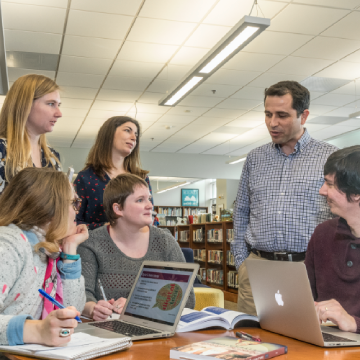
The Department of Educational Research Methodology offers three degree programs: the M.S. program, the Ph.D. program, and the joint M.S./Ph.D. program. These programs have distinct goals that align with particular training and career objectives. The curriculum of these programs has been carefully crafted to meet the needs of the career opportunities associated with each degree. The curriculum of our programs is reviewed on a regular basis by leaders of organizations specializing in research, assessment, and program evaluation to ensure that our training is optimally aligned with the needs of their organizations.
M.S. Program: The M.S. program offers foundational training in research methodology appropriate for individuals (a) seeking a career providing methodological support to organizations, or (b) looking to ultimately pursue doctoral training in research methodology or other research-intensive substantive fields (e.g., education, psychology, health sciences) that employ quantitative methods. A portion of the M.S. degree constitutes elective courses that allow the student gain a concentration in a particular area of methodology, such as program evaluation, the measurement sciences, or statistical modeling. A more detailed description can be found on the Programs of Study page.
Ph.D. Program: The Ph.D. program provides comprehensive and rigorous training in research methodology appropriate for individuals serving as expert methodologists for a wide range of organizations, including assessment development and testing organizations, organizations specializing in program evaluation, and organizations conducting research in education and public policy. Students in the Ph.D. program gain expertise across a broad range of methodological approaches, but also concentrate in one or more specific areas of methodology, such as the measurement sciences, program evaluation, or statistical modeling. A more detailed description can be found on the Programs of Study page.
M.S./Ph.D. Program: The joint M.S./Ph.D. program allows the student to complete the M.S. and Ph.D. degrees on a timeline that is faster than if the two degrees were completed separately. This program is appropriate for individuals who wish to pursue a Ph.D. in research methodology, but have not yet completed the training of an appropriate master’s degree in methodology. A more detailed description can be found on the Programs of Study page.
Doctoral Minor: In addition to the M.S., Ph.D., and joint M.S./Ph.D. degree programs, the department also offers a Doctoral Minor in Educational Research Methodology for students enrolled in a UNCG doctoral program outside of ERM. This program is appropriate for individuals conducting a doctoral degree in a substantive field who wish to obtain thorough training in one or more areas of research methodology. A more detailed description can be found on the Programs of Study page.
ERM students benefit from a range of applied field experiences, including internships, practicums, and involvement in funded research and evaluation projects overseen by ERM faculty. Our students have been highly successful in securing desirable internships. In recent years, our students have completed internships in numerous organizations, including Educational Testing Service (ETS), Pearson, CTB/McGraw-Hill, National Council of State Boards of Nursing (NCSBN), ACT, the Program Evaluation Division of the North Carolina General Assembly, the Government Accountability Office in Washington DC, the College Board, Measured Progress, the Medical Council of Canada, Physicians for Peace, and Winston-Salem/Forsyth County Schools.
ERM highly values internship opportunities for its students, and formally supports these opportunities through its Office of Assessment, Evaluation, and Research Services (OAERS). The overall purpose of OAERS is to support the hands-on experiences of our students, with one of its functions being to facilitate internship opportunities for all ERM students. To do this, OAERS works continuously to cultivate on-going relationships with professional organizations that have internship opportunities that are aligned with the learning objectives of ERM’s programs. Then, through its Internship Matching Program, OAERS matches ERM students to available internship opportunities that are best stuited to each student’s professional goals. For more information about OAERS and its Internship Matching Program, click here.
Many ERM students are actively engaged in research. This holds true for all students in the Ph.D. and M.S./Ph.D. programs, but also is the case for some students in the M.S. program who are looking to continue on to a Ph.D. in the future. ERM students work closely with ERM faculty on research projects that are associated with particular areas of expertise of the faculty. These research studies span a wide range of topics in the measurement sciences, evaluation sciences, and statistical modeling. Some of the more recent research projects have addressed the following areas:
Measurement Sciences: cognitive diagnostic modeling, multivariate item response theory methodology, item response theory models for polytomous item formats, parameter estimation in measurement models, language assessment and testing, measurement invariance and differential item functioning, assessment engineering, computer adaptive testing, multistage testing, linking and equating, using mixture models to solve applied measurement problems
Evaluation Sciences: evaluation methodologies, mixed methods, case study methodology, qualitative methodology, software applications for evaluation
Statistical Modeling: mixture modeling, latent variable modeling, hierarchical linear modeling
Within these different areas, research studies can be either applied or technical in nature. Applied projects tend to use real data to demonstrate how different methodologies can be used to solve real-life issues in research, assessment, and evaluation. Technical projects focus on developing new methodologies or answering questions about the quality and properties of currently available methodologies (e.g., which methods are best under which conditions?). Technical projects in the areas of the measurement sciences and statistical modeling will often employ computer simulation studies or statistical theory to uncover the properties of the relevant methodology or model. Although the spectrum of the type of research conducted by ERM students is broad, all projects share the common goal of advancing knowledge and practice in the field of research methodology. Many of our students present their research at national and international conferences such as the annual meetings of the American Educational Research Association, the American Evaluation Association, and the National Council on Measurement in Education.
For students and student advisors planning course sequences, it is often useful to have a schedule of anticipated ERM course offerings for the upcoming years. To meet this need, we have constructed a document containing the anticipated ERM course offerings for the next several years. It is important to note that this is a list of expected future course offerings, and deviations from this schedule may occur depending on the availability of faculty to teach courses and student enrollment numbers.
You can download the tentiative schedule of future ERM course offerings by clicking here.